
Spring has sprung! Now’s the perfect time to refresh your emergency supplies, restock essentials, and update your plans. Stay ahead of the season by getting prepared!
Dive into the stories we’ve packed into this issue—there’s plenty to keep you informed and inspired.
In this issue:
- Spring drill
- Radio Corner: Band plan
- Training Review: Building Sides
- NERT Quarterly Calendar
- Vest Fodder
Published on April 2nd, 2025.
Comments? Drop us a line anytime: sffdnertnewsletter at gmail.com
It’s Drill Time!
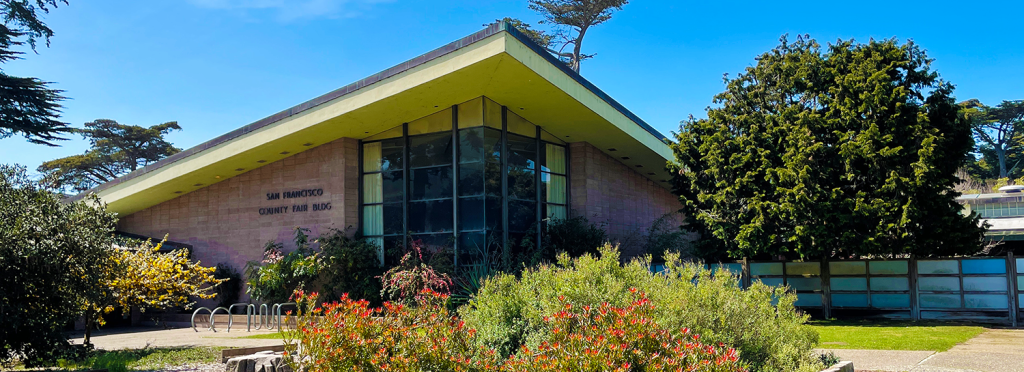
“San Francisco County Fair Building” by frankfarm is licensed under CC BY-NC-ND 2.0.
Register Now For The Spring Drill
We look forward to seeing you at the 2025 NERT Spring Drill, which will take place at the San Francisco County Fair Building, on Saturday April 19, 2025 ! We are excited to host the drill in the Inner Sunset as we work to bring drills to different neighborhoods; remember, we may respond to a neighborhood other than where we live.
We need your help! This location will put NERT very much in the public view in Golden Gate Park. We need you to join your fellow NERTs to show our strength in numbers as volunteer responders. Who knows, this could inspire more of our neighbors to become NERTs.
This drill will include some NERT favorite exercises, something new to get us out into the adjacent neighborhood, and opportunities to pass messages from field teams to staging areas and battalion command.
Registration is now open in the new NERT online app. Free lunch will be provided! Please help us avoid food waste; RSVP by Friday, April 11, 2025, 2359 hours (11:59 pm) if you want lunch. This will allow our caterer time to prepare the appropriate amount of food. 🥪 🏆
Event Details:
- Location: San Francisco County Fair Building
- Date: Saturday, April 19, 2025
- Check-in and coffee: 8:00 am
- Welcome remarks & instructions: 8:30 am
- Lunch: will be provided
You know you want to join us; register now! If you register after 04/11/23, we can’t guarantee you lunch.
(Trouble accessing the registration system, please contact the NERT office at sffdnert at sfgov.org )

Radio Waves
Band plan, what?
Alright, imagine you’re part of a NERT field team, and you need to get info to your staging area. You could use two people as “runners,” and they’d literally run the message.
But here’s the problem: people get tired! So, running messages over long distances or getting info there fast, is tough. It’s slow and takes a lot of energy.
Instead, we can use amateur radio. Using radios, we can send messages from a field team to a staging area, or from a staging area to a battalion station. This lets us share information way faster and with way less running around.
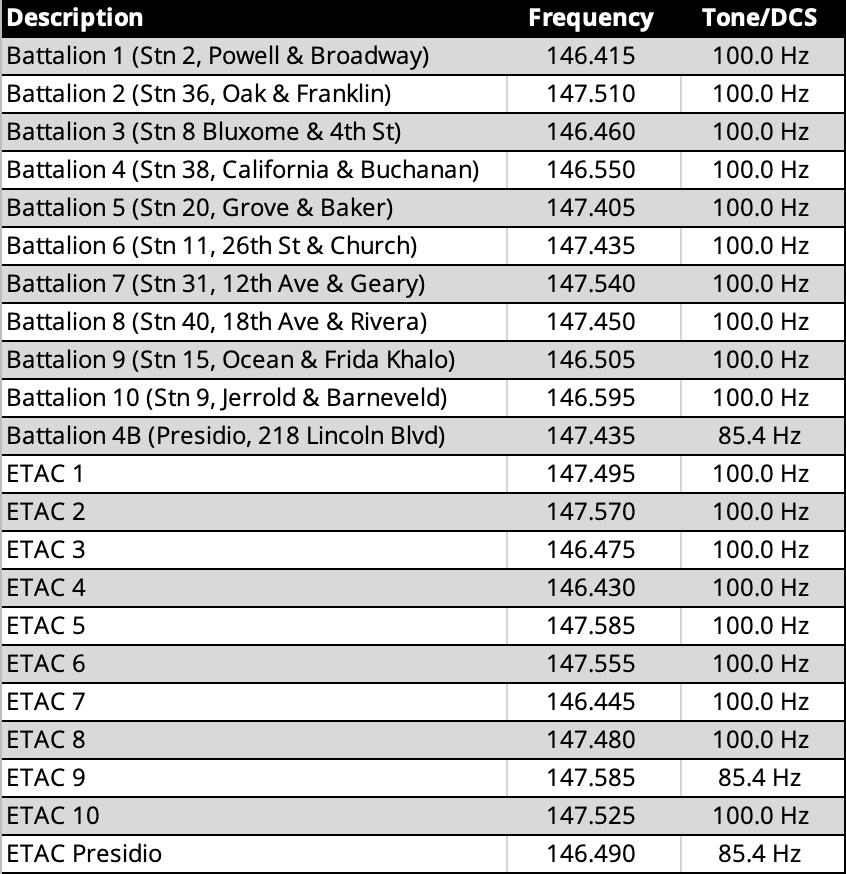
For two amateur radio operators to communicate directly with each other, their radios need to be tuned to the same frequency. The NERT band plan standardizes the frequencies by battalion, so NERTs can pre-program all frequencies into their radio in advance. This makes it easier for NERTs to respond if there is a need outside of their own neighborhood.
If you are a licensed amateur radio operator, be sure your radio has the current band plan, shown here:
SKILLS REFRESHER:
BUILDING SIDE LABELS
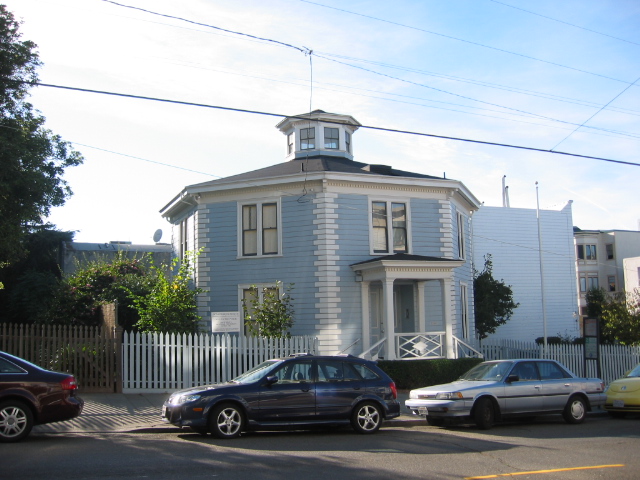
“Octagon house, San Francisco” by Dudesleeper at English Wikipedia is licensed under CC BY 2.5.
A simple standard: it starts @ the front door
As NERT Volunteers, we work to support the SFFD by being the eyes and ears of the firefighters after an earthquake, walking our neighborhoods, and performing and reporting neighborhood assessments.
In a clockwise direction from the front or address side while looking down on the building
Firefighting Standard
Firefighters label building sides with letters like A, B, C, and D to establish a standardized system for communication and orientation during emergency responses. This system helps ensure that all responding units are aware of the building’s location and layout, which is crucial for effective and safe operations.
Labeling sides alphabetically in a clockwise direction from the front or address side (typically designated as Side A) allows for clear and consistent communication among emergency responders. This helps prevent confusion and ensures that everyone is referring to the same areas of the building.
As NERTs, we would use building side letters during a neighborhood assessment, as example:
- All windows are broken on side B.
- Meter needles were spinning. Shut the gas off at the meter on side D.
- Large cracks in the stucco on sides A and D, are visible from the street.
Examples
This four-sided building has its front door/address on Harrison St., so this is side A. Looking at the next side clockwise, the one on the left becomes side B. Continuing clockwise, the side on the top in this illustration is side C. The last side, facing 19th St., is side D.

This six-sided building has a front door/address on a side close to 19th St. Then, looking clockwise, we see side B on the top of this illustration, continuing clockwise until the sixth side is identified as side F.

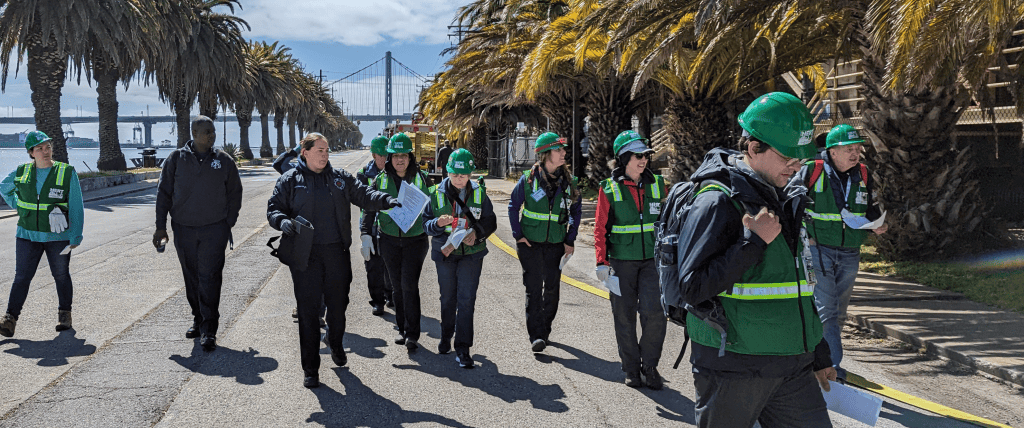
We Drill to Grow
Grow your skills!
Sharpen Your Skills, Strengthen Your Community
You, as a NERT, are vital to our community’s resilience. When disaster strikes, NERT members become, as volunteers, the first responders, providing crucial support to neighbors and professional first responders. Consistent training and drills are essential to ensure these teams are ready!
The upcoming bi-annual drill offers invaluable benefits for all NERT members:
- Skill Enhancement:
- Hands-on Practice: Hone vital skills like search and rescue, first aid/CPR, fire safety, triage, and light search and rescue in a controlled environment.
- Identify Weaknesses: Pinpoint areas for improvement and receive targeted training to enhance individual and team capabilities.
- Improved Teamwork & Communication:
- Strengthened Team Dynamics: Enhance teamwork, leadership, and decision-making within the NERT team, fostering cohesion and efficiency.
- Clear Communication: Refine communication protocols for clear and concise information exchange within the team and with other agencies.
- Building Community Connections:
- Meet Your Neighbors: Connect with other NERT members from across the community, fostering a strong network of support and mutual aid.
- Community Preparedness: Become an ambassador of preparedness within your community, encouraging neighbors to prepare for emergencies.
- Staying Current:
- Evolving Best Practices: Stay updated on the latest emergency response techniques and protocols, ensuring the most effective and efficient response strategies.
- Adapting to Evolving Threats: Prepare for a wide range of emergencies, from natural disasters to technological hazards.
The upcoming Spring 2025 NERT Drill is not just about improving skills; it’s an investment in your community. By actively participating, you demonstrate your commitment to serving your neighbors and ensuring their safety and well-being.
A Call To Action
We urge all NERT members to attend. Let’s come together, train diligently, and be ready to respond when called upon.
(Trouble accessing the registration system, please contact the NERT office at sffdnert at sfgov.org )
NERT Quarterly Calendar
As we move through the rain and cool weather of winter into the less predictable spring weather here in San Francisco, let’s use this time to level up our skills with in-person and free online training.
We’ve added FEMA self-study classes to this set of calendars. We’ve done so because many organizations, such as NERT, the Auxiliary Communication Service, hospitals, and the IT Disaster Response Team, require their members and employees to take these classes. Grow your skills and become a better-prepared NERT.
As more events are published throughout the quarter, we’ll update this to inform you of those events.
APRIL
All-month self-study: FEMA – Introduction to Community Emergency Response Team IS-317 ‡
7: ‼️📣 NERT Full Training (TUE AM) Tell your friends and neighbors! 📣
12: 2 Meter Critical Mass Radio Practice*
19: Citywide Drill – Register now via NERT APEX
19: Map Your Neighborhood – Portero Library
MAY
All-month self-study: FEMA – An Introduction to the National Incident Management System IS-700 ‡
10: 2 Meter Critical Mass Radio Practice*
17: NERT DAY@DOT – Watch for details in an e-mail
JUNE
All-month self-study: FEMA – Basic Incident Command System for Initial Response ICS-200 ‡
14: 2 Meter Critical Mass Radio Practice*
21: NERT DAY@DOT – Watch for details in an e-mail
JULY
All-month self-study: FEMA – National Response Framework, An Introduction ICS-800 ‡
12: 2 Meter Critical Mass Radio Practice*
19: NERT DAY@DOT – Watch for details in an e-mail
‡ This class is not instructed by NERT; rather, it is an online-only curriculum provided by FEMA. Upon completing the class, you will receive a digital certificate of completion from FEMA.
* Please note that some events are unaffiliated with the NERT Program. The NERT program is not responsible for its content.
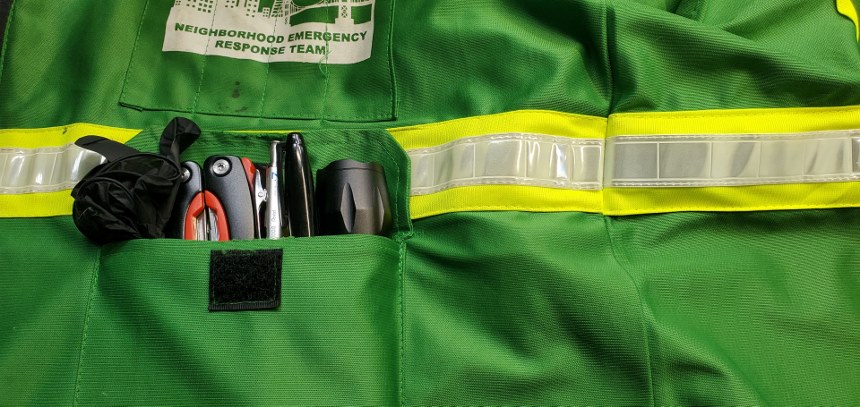
Vest Fodder
New San Francisco Ordinance –
San Francisco has seen a dramatic increase in fires caused by lithium-ion batteries in recent years. These fires can be particularly devastating due to the chemical hazards that make up the batteries, their tendency to flashover and grow quickly in size, and the difficulty of extinguishing them. Learn more about the ordinance and make your house safer here.
MyShake
If you have not yet, please install the MyShake app on your smartphone to help get timely earthquake early warnings.
Apple/iOS: https://apps.apple.com/us/app/myshake/id1467058529
Android: https://play.google.com/store/apps/details?id=edu.berkeley.bsl.myshake
NERT Slack Channel
Besides our newsletter, the NERT Slack Channel is another way to stay in touch. While not a replacement for Regroup, it does offer messaging and communications for NERT members. To subscribe on Slack, drop an email to: sffdnertnewsletter at gmail.com, and we’ll send you a link. Please use a real name, no nicknames or handles.

Have a Story Idea?
Let Us Know!
If you have an idea for an article or story for our newsletter, please pass it on to sffdnertnewsletter AT gmail.com.
We welcome your ideas and want this to be an inclusive and encompassing newsletter.
Let us know how we’re doing, please complete this survey!
The Disaster Dispatch is usually published quarterly in January, April, July, and October.
Credits
AI has assisted in various parts of story creation and editing.
AI-generated images by Adobe Firefly, Google Gemini.
Trouble Viewing This?
Certain email tools may not render this page correctly. Try opening the document in a different browser.
The Disaster Dispatch is a publication of the SFFD NERT Program. All Rights Reserved.


One response to “The Spring 2025 Issue”
[…] We’re going to have a radio activity during this drill, so make sure your batteries are charged and you have the current NERT Band Plan. […]
LikeLike